ANCHOR | Navigating Change



Any intelligent fool can make things bigger and more complex. It takes a touch of genius, and a lot of courage, to move in the opposite direction.
- Statistician and economist, E.F. Schumacher

Diversification is treated as a business virtue so unquestioned it borders on dogma. Expand the product line. Enter new markets. Hedge every risk. Spread exposure everywhere. Yet for many entrepreneurs, diversification may actually bring more risk than it solves. We examine whether more really is safer, and explore why simplicity, not spread, is often the real competitive advantage. Diversification makes perfect investment sense – but it doesn’t always make business sense.
Diversification makes intuitive sense. When one revenue stream falters, another should compensate. When one market cools, another heats up. In theory, it’s prudent. In reality, however, as businesses accumulate products, geographies, customer segments and internal processes, decision-making slows and execution weakens. What began as risk management turns into managerial overload. The uncomfortable truth is that sometimes executing fewer things extraordinarily well, for longer than competitors can tolerate, is sometimes the path to true success. Whether you’re selling koeksisters from your garage or leading a multinational tech behemoth, the ten pointers below are worth taking note of.
Diversification offers psychological comfort. It gives leaders the sense that they are “covered” from uncertainty. But safety in theory is not safety in execution. Each new product, market or channel introduces its own operational demands, regulatory requirements, customer expectations and failure points. Risk doesn’t disappear, it fragments. Instead of managing one or two critical risks deeply, leadership is forced to shallowly monitor many. The illusion of safety often masks a rise in systemic fragility.
Every additional business line adds meetings, reporting layers, decision pathways and coordination costs. These costs rarely appear cleanly on an income statement, but they erode margins all the same. Management attention becomes diluted. Strategic conversations shift from “How do we win?” to “How do we keep everything from breaking?”
Focused companies learn faster. They serve customers better because feedback loops are tight and clear. When something goes wrong, causes are easier to identify and fix. When something goes right, it can be scaled with confidence. Diversified organisations often struggle to replicate this clarity. Success in one unit is obscured by mediocrity in others. Focus doesn’t just improve execution, it sharpens strategic judgment.
One of the most under-discussed drivers of diversification is discomfort. When growth slows in the core business, expanding outwards can feel more exciting than fixing what’s broken. Unresolved issues, weak unit economics, unclear positioning, operational inefficiencies … These things don’t vanish when you diversify, they multiply to new areas. The same leadership blind spots and process failures are often replicated across a wider footprint. If you’re wondering whether diversification might be hurting you, feel free to ask for our input – sometimes a fresh perspective is all it takes.
What works brilliantly in one context rarely translates seamlessly into another. Different customer segments require different value propositions. Different geographies demand different logistics, pricing structures and cultural understanding. Founders often underestimate how bespoke excellence truly is. Horizontal expansion assumes transferable competence – but in reality, each new area requires its own learning curve. The result can be a portfolio of businesses that are all “good enough,” but none exceptional.
Speed is one of the greatest advantages of entrepreneurial organisations. Diversification erodes it. As organisations grow broader, decisions require more stakeholders, more data reconciliation and more compromise. What once took days now takes weeks. Opportunities expire while you’re trying to coordinate a Teams meeting to discuss them. In fast-moving markets, this loss of velocity can be fatal. Competitors with narrower focus can outmanoeuvre diversified incumbents simply by deciding, and acting, faster.
Strong brands stand for something specific. They occupy a clear mental position in the customer’s mind. Diversification blurs that signal. Customers struggle to understand what the company truly excels at. Is it premium or mass? Specialist or generalist? Innovative or reliable? When brand meaning weakens, pricing power follows. What was once differentiation becomes confusion – and confusion is rarely profitable.
History is filled with companies that endured precisely because they stayed narrow. They dominated niches, controlled quality obsessively and reinvested relentlessly into their core advantage. Their resilience came not from spread, but rather from deep customer relationships, deep expertise and deep operational mastery. Concentration allowed them to absorb shocks because their fundamentals were strong, not because they were hedged.
Rejecting diversification does not mean rejecting growth. It means choosing growth paths that reinforce the core rather than distract from it. Vertical integration, geographic expansion of a proven model, or deeper penetration of the same customer segment can all drive scale without overwhelming complexity.
Most businesses diversify because they can, not because they should. Capital is available. Talent is curious. Opportunities appear abundant. But the cost of complexity is rarely paid upfront, it is paid slowly, in lost clarity, slower execution and diminished excellence. Leaders who understand this ask a harder question: what must we protect at all costs and what are we willing to walk away from?


The avoidance of taxes is the only intellectual pursuit that still carries any reward.
- John Maynard Keynes

As we approach the end of the tax year, now is an ideal time to make a few strategic adjustments that can strengthen your financial position. These steps are simple, high-impact, and designed to help you make the most of the tax incentives available to South Africans. Read on to make sure you end the tax year right.
Contributing to a Retirement Annuity (RA) before 28 February can reduce your taxable income and grow your long-term wealth. If you haven’t maximised your annual tax deduction for contributions to retirement funds, this is a good moment to review it. Got any questions – ask us.
Each member of your family (even minor children) can have a TFSA and you can contribute up to R36,000 per year to each account. Interest and dividends paid from and capital growth inside a TFSA are completely tax-free, making it one of the most powerful long-term investment tools available.
Donations to qualifying Public Benefit Organisations (PBOs) and some other donees that are approved to issue section 18A receipts, are tax-deductible (up to 10% of taxable income). If you’re planning to give, now is a good time to do so.
If you’ve realised capital gains this year, you may be able to offset them by realising losses on underperforming investments. This is known as “tax‑loss harvesting” and can help reduce your capital gains tax. If you’re unsure if this applies to you, we can definitely assist. There is also a CGT exclusion (up to R2 million in gains) on the sale of your primary residence so the timing of your house sale may have big tax implications (positive or negative).
South Africans enjoy an annual local interest exemption of R23 800 (R34 500 for individuals 65 or older). If your interest income is close to or above the threshold, it may be worth reviewing where your cash is held and whether a more tax-efficient structure makes sense. Our advice here could be crucial.
Make sure you have the necessary documents from your investment platforms, including:
These will make your tax return smoother and help avoid SARS mismatches.
If you’ve had out-of-pocket medical costs or other deductible expenses, gather those records now so they’re ready for your return.
If you’re a provisional taxpayer, your second payment is due at the end of February. Ensuring your estimate is accurate can help you avoid penalties later.
If you’d like help reviewing any of these items or want to explore opportunities specific to your financial plan, we are here to support you.


The difference between successful people and really successful people is that really successful people say no to almost everything.
- Warren Buffett

Business culture is obsessed with speed. In a world where motion, and constant optimisation is the dream, doing nothing can look like failure. Entrepreneurs, CEOs and other leaders are praised for quick decision making, rapid iteration, and relentless action, yet many of the highest performers quietly practise the opposite at critical moments. They pause. They wait. They refuse to react. Strategic inaction is often one of the most disciplined and profitable decisions a business leader can make.
In a world where constant activity is seen as progress, the real high-performing leaders are doing something different. These entrepreneurs, CEOs and founders understand that not every signal deserves a response, not every problem requires an immediate solution, and not every opportunity is worth pursuing. In volatile markets, noisy feedback loops and emotionally charged leadership environments, doing nothing can be the hardest and smartest move you’ll ever make. Here’s why.
If the data is weak, contradictory, or incomplete, action often locks in the wrong conclusion. High-performing founders pause to gather better inputs, test assumptions, or wait for the environment to stabilise. Acting early may feel decisive, but it increases the chances of rework and wasted capital. Don’t hesitate to consult with your accountant, or other experts while you wait to ensure all data is as complete as possible before acting.
Many issues in start-ups resolve on their own: customer complaints from edge cases, short-term revenue dips, internal friction during growth… Founders who intervene too early often create processes, complexity, or cost for problems that would have disappeared organically. Strategic inaction prevents over-engineering.
Hiring senior executives, firing key staff, pivoting your business model, or entering long-term contracts are all hard to undo. High-performing founders deliberately slow these decisions. Waiting allows emotions to settle and consequences to become clearer. Speed matters, but not when mistakes are expensive.
Founders are most likely to act badly when under stress. Losing a client, missing a target, or facing criticism is guaranteed to heighten feelings. Strategic inaction creates distance between the stimulus and the response. This reduces decisions driven by fear, ego, or the need to appear in control.
When something underperforms, the instinct is to intervene. You would be better off first asking whether the system has had enough time to work. Premature changes make it impossible to know what is actually effective. Doing nothing (for a while) is often the fastest way to learn.
Every new initiative pulls attention away from existing priorities. Try to recognise that your company’s capacity is limited. By choosing not to act, you will protect delivery on what already matters. This is especially important as teams scale and coordination costs increase.
Waiting can reduce uncertainty. Competitors reveal their strategies. Markets clarify. Customer behaviour becomes more predictable. Strategic inaction is often about allowing risk to resolve itself before committing resources.
Doing nothing is not neutral. It must be intentional, reviewed, and time-bound. Experienced entrepreneurs track what they are choosing not to do and reassess regularly. Remember, strategic inaction works only when paired with attention and accountability.


Today, it takes more brains and effort to make out the income tax form than it does to make the income.
- Alfred E. Neuman, Mad Magazine Mascot

The second provisional tax deadline for the 2026 financial year is just days away on 27 February 2026. This is an important and tricky deadline, because this second provisional tax estimate must be quite accurate (within 80–90% of actual taxable income) to avoid SARS’ stiff under-estimation penalty. Find out how we can help you to meet this important deadline with the highest accuracy.
Provisional tax is among the most confusing aspects of the tax regime – and it’s also the most heavily penalised. There are numerous declarations and payments overlapping throughout each year, not to mention a raft of rules and exceptions. The next provisional tax deadline for the 2026 tax year (coming up on 27 February 2026) is also the trickiest and most important provisional tax deadline of the year. This is because the income estimates declared must be highly accurate. A stiff 20% under-estimation penalty can apply if the declared income estimate doesn’t fall within 80–90% of the actual taxable income. Our professional assistance is your ticket to avoiding non-compliance and stiff penalties.
Provisional tax is not a type of tax, but rather a way of paying an annual income tax liability in two or three payments during a tax year. This prevents taxpayers from facing one large tax bill at year-end when the annual personal income tax (PIT) return or corporate income tax (CIT) return is filed.
Making provisional tax payments allows you to spread the tax liability across the year. But it also creates additional administrative obligations (calculations, returns), and increases the risk of penalties – particularly under-estimation penalties.
The following rules apply to individuals and to companies / trusts with a year of assessment running from 1 March to 28 February:
Bear in mind that SARS can ask for your estimate to be justified, so you’ll need accurate records of all source documents and calculations used. SARS can even increase the estimate if they’re dissatisfied with your amount, and this is not subject to objection or appeal.
The rules of provisional tax are daunting and confusing, yet SARS holds provisional taxpayers responsible for their tax affairs. SARS recommends that the provisional tax estimate is determined sensibly and by careful reasoning and judgement, in a mathematical manner, and using experience, common sense and all available information.
Our professional assistance is invaluable as you prepare and review your provisional tax and income tax returns prior to submission. We proactively take care of all necessary steps to correctly calculate estimated taxable income and submit timeously – in the process saving you time, money, and hassle.


People don’t mind price increases as much as they mind surprises.
- Robert Cialdini, Psychologist and Business Author

Price changes are part of running a business at this time of the year, and generally one of the first things business owners consider when they return to the office. Many owners, however, still treat increases as a last resort and/or fear making them – even when rising costs make them unavoidable. Here are our tips for increasing prices in the most effective (and least disruptive) way.
Costs go up and so do prices. And yet most businesses raise prices later than they should. A global study by Simon-Kucher found that less than a quarter of companies adjust prices multiple times a year as needed, with almost 30% discussing price changes only once annually, and 26% waiting for new customer tenders or contract expirations. By the time owners take action, margins are stressed and the communication feels rushed. This is unfortunate, because studies show that a thoughtful considered, and timeous approach is the difference between a customer accepting a change and walking away.
“We’ll lose customers if we raise prices”
This fear is common, but it’s not grounded in the research. Studies from the Harvard Business Review note that when customers leave after a price change, it’s usually because the business has stayed quiet about the reason. Silence erodes trust. People assume the worst, even when the increase is modest. The same study revealed that most customers accept changes if they still see value and understand why the adjustment exists. Communication is key. Your customers should know what costs shifted and what value you’ve added. Keep the message simple enough that a customer could repeat it back without confusion.
“Customers won’t care about the reason”
Owners often assume customers ignore explanations. Evidence says the opposite. Research from McKinsey & Company found that when companies explain the drivers behind price changes, such as rising input costs or service improvements, customer trust remains stable, even when the increase is noticeable. People don’t need all the details, but they definitely do want you to add context. A short, fact-based explanation helps them understand that the decision wasn’t arbitrary or simply based on greed.
“If we apologise enough, customers will be less upset”
For many owners the first inclination is to apologise to the customer for the added pressure the price changes will have on their lives. Trying to soften the blow with an apology frames the price change as a mistake rather than a strategic choice. Customers may wonder whether the change is temporary or negotiable, thereby weakening your position. This is all backed up by researchers writing in the Journal of Service Research who note that apologies work best when something has gone wrong. You can acknowledge the impact on customers without presenting the change as an error. Aim for respectful, not remorseful.
“We should wait until the last minute to avoid backlash”
Delaying the announcement doesn’t reduce resistance, it magnifies it. Short notice announcements leave customers scrambling. If the increases catch them off guard this can lead to resentment – something that’s far more likely to lead them to change supplier than the price change itself. Giving your customers timely notice shows that you respect their planning and cash flow. You should aim to communicate price increases as early as possible. Even a few weeks’ notice can make the shift easier. Use one message delivered consistently across email, invoices, signage, and your website so there’s no confusion.
“Once we announce the increase, the conversation is over”
Many businesses make their price announcement and stop there. Whether from fear of pushback or simply a desire to not discuss it, their refusal to discuss the price changes with customers can often lead to unanswered questions, and confusion, leaving space for assumptions to grow. Studies from Gartner highlight that businesses with strong post-announcement engagement retain more clients than those who treat the update as a one-way message. You should always be prepared for questions. Have a short script or FAQ ready. Make sure your team is aligned so they answer consistently. A calm explanation helps people adjust without feeling ignored.
“The only way to justify an increase is by adding new features”
Price increases don’t always need to come with updates or added features. Often they simply reflect the realities of the economy. Businesses that fail to keep pace eventually struggle to maintain service quality and people understand that. This does not mean that you shouldn’t tell customers when price changes are related to improved offerings. Telling customers about upgrades gives them something concrete to weigh against the higher price. Under-explaining value is as harmful as over-explaining it.
“A single announcement will do”
People miss emails. They skim invoices. They forget dates. A single notice is rarely enough, even when well written. When a message is clear and consistent, customers don’t feel overwhelmed. Using multiple channels for communication has been shown to reduce complaints because no one feels blindsided. You should always aim to send your message through two or three channels, spaced out over time. Keep each version short and factual and make sure they each reflect the same message. Clarity prevents conflict.
What’s the takeaway?
Customers respond well when they feel informed rather than managed. They respond poorly when communication is rushed, vague, or emotional. When customers know the reasons behind changes, they are much more likely to stay loyal – even when the price goes up.
If you want help reviewing your pricing structure, chat to us.


The outlook is clear: resilience and innovation will define Africa’s growth story.
- Ignatius Sehoole, CEO of KPMG South Africa

“A continent brimming with optimism.” This is how KPMG’s 11th Africa CEO Outlook describes Africa. Among the African CEOs surveyed, 63% expressed optimism about their country’s growth prospects and 78% expressed strong business confidence. Over the short term, 98% expect business expansion and 86% are likely to pursue acquisitions.
“African CEOs are not only adapting to global challenges but are actively investing in the future through AI, talent, and sustainable growth strategies,” explains Ignatius Sehoole, CEO of KPMG South Africa. Most CEOs globally (79%) also say they are optimistic about their own organisations’ prospects and the majority anticipate rising revenues over the next three years. Like their African counterparts, they are doubling down on AI, talent investment and ESG as the keys to resilience and growth.
CEOs, globally and in Africa, face very similar challenges. This has made them more deliberate when deciding how to channel their resources.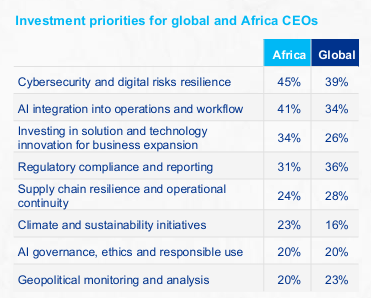
Source: 2025 Africa CEO Outlook – KPMG South Africa
In addition, in Africa, CEOs are increasingly prioritising intra-African trade and market expansion on the continent.
For African and global CEOs heading into 2026, AI is a top strategic priority. 26% of African CEOs plan to allocate more than 20% of their annual budget to AI in the next 12 months, almost twice the global average of 14%. This high level of investment by African CEOs reflects a shift in mindset, with AI being viewed not only as a tool for future growth, but as an immediate lever for operational efficiency, better decision-making, and long-term resilience.
To deploy and scale AI, African organisations are faced with three options: build, buy or partner. “Each organisation must weigh the pros and cons of building, buying, or partnering for AI solutions. There is no one-size-fits-all-approach. The right strategy depends on the organisation’s existing capabilities, risk appetite and strategic objectives,” explains Joelene Pierce, CEO Designate of KPMG South Africa.
Among African CEOs surveyed, 88% expect to increase headcount over the next year and 62% are focusing on retaining and re-training high-potential talent. The majority (81%) believe that upskilling in AI will directly impact their success and more than two thirds (67%) are redeploying staff into AI enabled roles. These numbers, too, closely reflect global perspectives, with 92% of CEOs expecting to increase headcount next year, and 77% agreeing that AI upskilling will directly impact business success. Already, 71% are focusing on retaining and retraining high-potential talent, and 59% are redeploying staff into AI enabled roles.
Despite regulatory complexity, African CEOs remain committed to Environmental, Social, and Governance goals. Almost half (46%) are aligning sustainability goals with core business strategies, 51% are prioritising compliance and reporting, and 74% are using AI to reduce emissions and improve energy efficiency. Globally CEOs are also indicating rising confidence in meeting climate targets, with 61% saying they are on track to hit their 2030 net zero targets. In addition, 65% indicate that they have fully embedded sustainability into their business and believe it is critical to their long-term success.
Most CEOs (59%) say that expectations and complexity of their roles have evolved significantly in the last five years, and 80% feel under more pressure to ensure long-term business prosperity. Yet, even with change and challenge as the “new normal”, CEOs are actively building resilience by investing in AI, talent, and sustainable growth strategies, and are moving forward confidently to greater success in the year ahead.


A fresh start is not a place, it is a mindset.
- Jordan Peterson

Harnessing the New Year’s “fresh start effect” can have a significant impact on your team’s motivation as they get back into the swing of things. Read on to find out how what you do at this time of year can influence your team’s performance all year long. Kicking the year off in the right manner might be the best investment you ever make…
The beginning of the new year can be more than another Monday morning: it can be a powerful psychological reset button.
The ‘fresh start effect’ comes after milestones, like New Year’s or anniversaries, that help people believe they can become better versions of themselves – and this applies just as powerfully to teams as it does to individuals. It’s as if a mere calendar flip wipes the slate clean, making new commitments feel more achievable and reducing the emotional weight of past disappointments. When your team returns from the holiday break, they aren’t just rested – they are primed for change, and feeling capable of achieving goals that might have seemed daunting just weeks earlier.
The “fresh start effect” creates a window of heightened motivation, but it is only temporary. Research consistently shows that initial New Year’s enthusiasm naturally fades without proper structure and ongoing engagement. The challenge then is to convert this early motivation into sustainable systems. Timing matters. Schedule your most important organisational initiatives, strategic planning sessions, and team goal-setting meetings in these early weeks of January. The psychological conditions are optimal right now, as your team feels capable, refreshed, and ready for change. Use this window to establish the habits, routines, and systems that will carry you through the entire year.
Start by setting specific and measurable goals. Clear and quantifiable goals significantly improve employee engagement and productivity. Break annual targets into smaller quarterly or monthly milestones to prevent overwhelm and provide regular opportunities to maintain momentum and celebrate progress. Team-based goal setting enhances overall performance because it creates accountability, builds collective commitment, and ensures that everyone understands how their individual efforts contribute to larger team goals.
The fresh start effect can be a catalyst for creating systems, habits, and cultural practices that sustain performance all year long. Visual progress tracking taps into our psychological need for achievement and keeps the momentum alive. Implement regular check-ins and progress reviews — at least monthly. These touchpoints maintain accountability, allow for course corrections, and provide opportunities to celebrate wins.
You can also engineer temporal landmarks throughout the year. Things like monthly reset days, quarterly planning sessions, or team offsite retreats… These moments provide mini fresh starts that can reignite motivation when energy naturally dips. Use these inflection points for team brainstorming sessions, strategic pivots, or launching new initiatives. The psychology works the same way: you’re creating a sense of temporal separation that makes change feel achievable.
The new year brings a gift: a team that believes change is possible and feels capable of achieving goals.


If you can’t measure it, you can’t improve it.
-Peter F. Drucker, Business Management Guru
The start of a new year brings a powerful urge to chase the future. We get excited about new projects, bigger revenue targets, and a fresh start. But jumping into new resolutions without an honest, data-driven audit of the last twelve months is like building a house without checking the foundations. Before you commit to a single resolution, you must pause and interrogate the year you’ve just completed by asking yourself these five simple questions.
Entrepreneurs are hardwired to look forward, and chase the next win. This constant looking ahead can create a costly strategic blind spot. When you rush past December’s data to write January’s plan, you run the risk of missing the critical lessons already paid for in time, money, and stress. A comprehensive review gives you the opportunity to pinpoint previous issues and create solid strategies for growth. Without this backward glance, your resolutions become a wishlist disconnected from operational reality. The key is turning reflection into a data-driven process, not a feelings-based one. Before you look for your new year’s resolutions, it’s therefore wise to sit down and answer these five precise questions.
The most common mistake in goal review is simply ticking boxes. You hit the revenue target – great. But why? While hitting a financial benchmark is great, understanding which tactics got you there is the real win. Instead of simply analysing KPIs, you should compare your initial goals with your final metrics. Analyse the data to understand what’s working and what isn’t. Was the goal achieved because a specific marketing campaign worked, or did an unexpected market event carry the result?
By identifying the exact steps, processes, or resource allocations that delivered the win you can prevent yourself from inadvertently eliminating a high-performing strategy in the new year or, worse still, believing a non-repeatable outcome is a sustainable strategy.
This question requires an honest, non-emotional audit of your financial and calendar commitments. It’s a review of efficiency, not just income. Beyond the simple rand amount, evaluate the return on investment for projects and tasks. As your accountants we can help by examining your cash flow, expenses, and budget adherence. Which recurring expense failed to generate its expected value? Is there enough money coming in, and are you staying within budget?
The next step is to look at which project delivered disappointing results compared to the time and effort it consumed. By identifying the single biggest time waster of the year for you and your key staff, you can cut inefficiencies and free up resources for genuinely productive initiatives.
Growth depends on staying relevant and competitive. Your business exists to solve a customer problem, and that problem and the best way to solve it changes constantly. The information you need to adapt is already in your email inboxes, support tickets, and sales reports. First analyse your customer feedback. By looking for common themes of satisfaction and dissatisfaction you can open up areas for new services and pinpoint areas where your process is disappointing your biggest clients. Follow this up with a thorough audit of the latest industry trends and competitor actions. This will help you keep abreast of market shifts.
Your biggest revelation for the new year often lies in the data points you tried to ignore because they conflicted with your original plan. Use this insight to adapt your business model and strategies proactively.
Every entrepreneur has a graveyard of half-finished projects. These are not just lines on a to-do list; they are sunk costs that continue to absorb cognitive load and drain mental bandwidth. You must address them before you plan the next project. Reflect on ideas that were shelved, dropped, or simply allowed to drift. Was the goal too ambitious, did you lose interest, or did more pressing tasks take priority? The reason often lies in poor prioritization or a fear of letting go.
Look at the list of unfinished items and make a binary decision for each:
Letting go of an unfulfilled goal removes operational and mental clutter. Avoid the trap of carrying dead weight into January.
Do not confuse a bottleneck with a challenge. A challenge is unique; a bottleneck is the same hurdle that surfaces repeatedly, slowing down every initiative. This could be a lack of standard operating procedures (SOPs), a poor communication structure, or an outdated software system.
The first step to eliminating a bottleneck is pinpointing the area that constantly holds up progress and causes stress. For example: “Our hiring process is inconsistent.” Or: “Data collection for client reports takes two full days.” Setting aggressive new goals on top of a broken system guarantees failure. Address the system first. If your resolution is to double output, but your internal approval process is the issue, a goal to fix the process is the only resolution that matters.
The purpose of these five questions is to clean the slate. By identifying proven wins, cutting wasted resources, integrating market lessons, clearing unfinished projects, and fixing critical bottlenecks, you can transition from hopeful resolution to strategic certainty.
Want help with making it happen? Our door is always open…


A rich man without charity is a rogue; and perhaps it would be no difficult matter to prove that he is also a fool.
- Henry Fielding

Helping others should be the simplest thing in the world, but the truth is there’s a lot more red tape than you might expect. You’re just trying to run a community project, but then you’re told you need to register as an NPO, but everyone’s calling you an NGO, your accountant says it might help to become an NPC and your donors are asking if you’re a PBO.
So, what’s the difference? And what’s the right choice for your philanthropic endeavours?
Across the country, tens of thousands of groups run feeding schemes, environmental projects, schools, clinics, and training centres, often built on passion rather than profit.
But while “NGO” is the word most people use, it’s not actually a legal term in South Africa. Entrepreneurs who fund or collaborate with non-profits need to know what each term really means, because it affects compliance, governance, and whether your donation qualifies for a tax deduction.
NGO (Non-Governmental Organisation) | NPO (Non-Profit Organisation) |
NGO is a broad, informal term used for any group doing social good outside of government. It could be a community group, a youth initiative, or a local charity. There’s no single registration for an “NGO” in South Africa and literally anyone can use the label. | An NPO is a specific legal status created by the Non-Profit Organisations Act. You need to apply to the Department of Social Development (DSD) with your constitution or founding document. Once approved, you get an official NPO number and a certificate that opens doors which funders, corporates and even banks. Non-Profit Companies (see below) can also apply to be NPOs, in which case both sets of rules apply. |
NPC (Non-Profit Company) | PBO (Public Benefit Organisation) |
Some charitable organisations register as NPCs with the Companies and Intellectual Property Commission (CIPC). This suits organisations that want a more formal company structure, complete with directors and a Memorandum of Incorporation. | Both NPOs and NPCs must apply to SARS to become PBOs if they want to unlock the tax benefits available to charitable organisations (more info below). |
Many groups, particularly small ones, will run perfectly well without registering. Registering does, however, bring a number of real advantages.
Any entrepreneurs working with or donating to a cause should always ask for proof of registration as an NPO or NPC.
Here’s where many people get caught out. Just because an organisation is registered as an NPO doesn’t mean they are automatically exempt from tax. To enjoy tax benefits, like exemption from income tax and giving donors section 18A certificates, the organisation must also apply to SARS for Public Benefit Organisation (PBO) status. (Being granted Section 18A status requires a separate approval on top of PBO status.)
That approval comes with conditions: funds must only be used for approved public-benefit activities, and annual returns must be filed. PBO status will always make an organisation more attractive to donors because their contributions can now become tax-deductible and exempt from donations tax.
NPOs | NPCs |
|
|
|
|
While this might sound like a lot of admin, it protects both sides. Donors get transparency, and the organisation builds a track record for future funding.
Anyone partnering with a non-profit should always review its governance set-up before committing resources and be able to answer the following questions:
If the answer is “yes” to all three, then you are working with an organisation that’s not just doing good – it’s doing good in the right way.
As your accountants, we can ensure that you’re taking advantage of all the tax benefits available to you.


Site Navigation
Contact Us
"*" indicates required fields
This website uses cookies so that we can provide you with the best user experience possible. Cookie information is stored in your browser and performs functions such as recognising you when you return to our website and helping our team to understand which sections of the website you find most interesting and useful.
Strictly Necessary Cookie should be enabled at all times so that we can save your preferences for cookie settings.
If you disable this cookie, we will not be able to save your preferences. This means that every time you visit this website you will need to enable or disable cookies again.