Month: January 2026

Our Top Tips for Communicating Price Changes

Our Top Tips for Communicating Price Changes.

People don’t mind price increases as much as they mind surprises.

Price changes are part of running a business at this time of the year, and generally one of the first things business owners consider when they return to the office. Many owners, however, still treat increases as a last resort and/or fear making them – even when rising costs make them unavoidable. Here are our tips for increasing prices in the most effective (and least disruptive) way.

Costs go up and so do prices. And yet most businesses raise prices later than they should. A global study by Simon-Kucher found that less than a quarter of companies adjust prices multiple times a year as needed, with almost 30% discussing price changes only once annually, and 26% waiting for new customer tenders or contract expirations. By the time owners take action, margins are stressed and the communication feels rushed. This is unfortunate, because studies show that a thoughtful considered, and timeous approach is the difference between a customer accepting a change and walking away.

“We’ll lose customers if we raise prices”
This fear is common, but it’s not grounded in the research. Studies from the Harvard Business Review note that when customers leave after a price change, it’s usually because the business has stayed quiet about the reason. Silence erodes trust. People assume the worst, even when the increase is modest. The same study revealed that most customers accept changes if they still see value and understand why the adjustment exists. Communication is key. Your customers should know what costs shifted and what value you’ve added. Keep the message simple enough that a customer could repeat it back without confusion.

“Customers won’t care about the reason”
Owners often assume customers ignore explanations. Evidence says the opposite. Research from McKinsey & Company found that when companies explain the drivers behind price changes, such as rising input costs or service improvements, customer trust remains stable, even when the increase is noticeable. People don’t need all the details, but they definitely do want you to add context. A short, fact-based explanation helps them understand that the decision wasn’t arbitrary or simply based on greed.

“If we apologise enough, customers will be less upset”
For many owners the first inclination is to apologise to the customer for the added pressure the price changes will have on their lives. Trying to soften the blow with an apology frames the price change as a mistake rather than a strategic choice. Customers may wonder whether the change is temporary or negotiable, thereby weakening your position. This is all backed up by researchers writing in the Journal of Service Research who note that apologies work best when something has gone wrong. You can acknowledge the impact on customers without presenting the change as an error. Aim for respectful, not remorseful.

“We should wait until the last minute to avoid backlash”
Delaying the announcement doesn’t reduce resistance, it magnifies it. Short notice announcements leave customers scrambling. If the increases catch them off guard this can lead to resentment – something that’s far more likely to lead them to change supplier than the price change itself. Giving your customers timely notice shows that you respect their planning and cash flow. You should aim to communicate price increases as early as possible. Even a few weeks’ notice can make the shift easier. Use one message delivered consistently across email, invoices, signage, and your website so there’s no confusion.

“Once we announce the increase, the conversation is over”
Many businesses make their price announcement and stop there. Whether from fear of pushback or simply a desire to not discuss it, their refusal to discuss the price changes with customers can often lead to unanswered questions, and confusion, leaving space for assumptions to grow. Studies from Gartner highlight that businesses with strong post-announcement engagement retain more clients than those who treat the update as a one-way message. You should always be prepared for questions. Have a short script or FAQ ready. Make sure your team is aligned so they answer consistently. A calm explanation helps people adjust without feeling ignored.

“The only way to justify an increase is by adding new features”
Price increases don’t always need to come with updates or added features. Often they simply reflect the realities of the economy. Businesses that fail to keep pace eventually struggle to maintain service quality and people understand that. This does not mean that you shouldn’t tell customers when price changes are related to improved offerings. Telling customers about upgrades gives them something concrete to weigh against the higher price. Under-explaining value is as harmful as over-explaining it.

“A single announcement will do”
People miss emails. They skim invoices. They forget dates. A single notice is rarely enough, even when well written. When a message is clear and consistent, customers don’t feel overwhelmed. Using multiple channels for communication has been shown to reduce complaints because no one feels blindsided. You should always aim to send your message through two or three channels, spaced out over time. Keep each version short and factual and make sure they each reflect the same message. Clarity prevents conflict.

What’s the takeaway?

Customers respond well when they feel informed rather than managed. They respond poorly when communication is rushed, vague, or emotional. When customers know the reasons behind changes, they are much more likely to stay loyal – even when the price goes up.

If you want help reviewing your pricing structure, chat to us.

Outlook 2026: Moving Forward with Confident Resilience

Outlook 2026: Moving Forward with Confident Resilience.

The outlook is clear: resilience and innovation will define Africa’s growth story.

“A continent brimming with optimism.” This is how KPMG’s 11th Africa CEO Outlook describes Africa. Among the African CEOs surveyed, 63% expressed optimism about their country’s growth prospects and 78% expressed strong business confidence. Over the short term, 98% expect business expansion and 86% are likely to pursue acquisitions.

“African CEOs are not only adapting to global challenges but are actively investing in the future through AI, talent, and sustainable growth strategies,” explains Ignatius Sehoole, CEO of KPMG South Africa. Most CEOs globally (79%) also say they are optimistic about their own organisations’ prospects and the majority anticipate rising revenues over the next three years. Like their African counterparts, they are doubling down on AI, talent investment and ESG as the keys to resilience and growth.

Common challenges & shared priorities

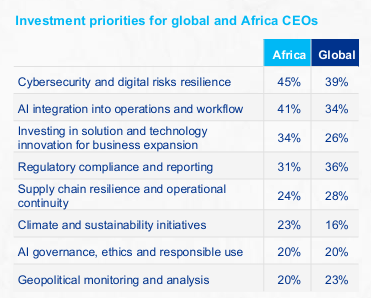
CEOs, globally and in Africa, face very similar challenges. This has made them more deliberate when deciding how to channel their resources.

Source: 2025 Africa CEO Outlook – KPMG South Africa

In addition, in Africa, CEOs are increasingly prioritising intra-African trade and market expansion on the continent.

AI: Top 2026 strategic priority

For African and global CEOs heading into 2026, AI is a top strategic priority. 26% of African CEOs plan to allocate more than 20% of their annual budget to AI in the next 12 months, almost twice the global average of 14%. This high level of investment by African CEOs reflects a shift in mindset, with AI being viewed not only as a tool for future growth, but as an immediate lever for operational efficiency, better decision-making, and long-term resilience.

To deploy and scale AI, African organisations are faced with three options: build, buy or partner. “Each organisation must weigh the pros and cons of building, buying, or partnering for AI solutions. There is no one-size-fits-all-approach. The right strategy depends on the organisation’s existing capabilities, risk appetite and strategic objectives,” explains Joelene Pierce, CEO Designate of KPMG South Africa.

Talent in the age of AI

Among African CEOs surveyed, 88% expect to increase headcount over the next year and 62% are focusing on retaining and re-training high-potential talent. The majority (81%) believe that upskilling in AI will directly impact their success and more than two thirds (67%) are redeploying staff into AI enabled roles. These numbers, too, closely reflect global perspectives, with 92% of CEOs expecting to increase headcount next year, and 77% agreeing that AI upskilling will directly impact business success. Already, 71% are focusing on retaining and retraining high-potential talent, and 59% are redeploying staff into AI enabled roles.

ESG and sustainability

Despite regulatory complexity, African CEOs remain committed to Environmental, Social, and Governance goals. Almost half (46%) are aligning sustainability goals with core business strategies, 51% are prioritising compliance and reporting, and 74% are using AI to reduce emissions and improve energy efficiency. Globally CEOs are also indicating rising confidence in meeting climate targets, with 61% saying they are on track to hit their 2030 net zero targets. In addition, 65% indicate that they have fully embedded sustainability into their business and believe it is critical to their long-term success.

Confident resilience

Most CEOs (59%) say that expectations and complexity of their roles have evolved significantly in the last five years, and 80% feel under more pressure to ensure long-term business prosperity. Yet, even with change and challenge as the “new normal”, CEOs are actively building resilience by investing in AI, talent, and sustainable growth strategies, and are moving forward confidently to greater success in the year ahead.

Harnessing the New Year’s “Fresh Start Effect” for a Great 2026

Harnessing the New Year’s “Fresh Start Effect” for a Great 2026.

A fresh start is not a place, it is a mindset.

Harnessing the New Year’s “fresh start effect” can have a significant impact on your team’s motivation as they get back into the swing of things. Read on to find out how what you do at this time of year can influence your team’s performance all year long. Kicking the year off in the right manner might be the best investment you ever make…

The beginning of the new year can be more than another Monday morning: it can be a powerful psychological reset button.

The ‘fresh start effect’ comes after milestones, like New Year’s or anniversaries, that help people believe they can become better versions of themselves – and this applies just as powerfully to teams as it does to individuals. It’s as if a mere calendar flip wipes the slate clean, making new commitments feel more achievable and reducing the emotional weight of past disappointments. When your team returns from the holiday break, they aren’t just rested – they are primed for change, and feeling capable of achieving goals that might have seemed daunting just weeks earlier.

Capturing the moment: Practical strategies for January 2026

The “fresh start effect” creates a window of heightened motivation, but it is only temporary. Research consistently shows that initial New Year’s enthusiasm naturally fades without proper structure and ongoing engagement. The challenge then is to convert this early motivation into sustainable systems. Timing matters. Schedule your most important organisational initiatives, strategic planning sessions, and team goal-setting meetings in these early weeks of January. The psychological conditions are optimal right now, as your team feels capable, refreshed, and ready for change. Use this window to establish the habits, routines, and systems that will carry you through the entire year.

Start by setting specific and measurable goals. Clear and quantifiable goals significantly improve employee engagement and productivity. Break annual targets into smaller quarterly or monthly milestones to prevent overwhelm and provide regular opportunities to maintain momentum and celebrate progress. Team-based goal setting enhances overall performance because it creates accountability, builds collective commitment, and ensures that everyone understands how their individual efforts contribute to larger team goals.

Building sustainable momentum beyond January

The fresh start effect can be a catalyst for creating systems, habits, and cultural practices that sustain performance all year long. Visual progress tracking taps into our psychological need for achievement and keeps the momentum alive. Implement regular check-ins and progress reviews — at least monthly. These touchpoints maintain accountability, allow for course corrections, and provide opportunities to celebrate wins.               

Creating fresh starts all year round

You can also engineer temporal landmarks throughout the year. Things like monthly reset days, quarterly planning sessions, or team offsite retreats… These moments provide mini fresh starts that can reignite motivation when energy naturally dips. Use these inflection points for team brainstorming sessions, strategic pivots, or launching new initiatives. The psychology works the same way: you’re creating a sense of temporal separation that makes change feel achievable.  

The long game: Making 2026 different

The new year brings a gift: a team that believes change is possible and feels capable of achieving goals.

The 5 Questions You Must Ask Before Making Your Business Resolutions

The 5 Questions You Must Ask Before Making Your Business Resolutions.

If you can’t measure it, you can’t improve it.

The start of a new year brings a powerful urge to chase the future. We get excited about new projects, bigger revenue targets, and a fresh start. But jumping into new resolutions without an honest, data-driven audit of the last twelve months is like building a house without checking the foundations. Before you commit to a single resolution, you must pause and interrogate the year you’ve just completed by asking yourself these five simple questions.

Entrepreneurs are hardwired to look forward, and chase the next win. This constant looking ahead can create a costly strategic blind spot. When you rush past December’s data to write January’s plan, you run the risk of missing the critical lessons already paid for in time, money, and stress. A comprehensive review gives you the opportunity to pinpoint previous issues and create solid strategies for growth. Without this backward glance, your resolutions become a wishlist disconnected from operational reality. The key is turning reflection into a data-driven process, not a feelings-based one. Before you look for your new year’s resolutions, it’s therefore wise to sit down and answer these five precise questions.

1. Which goals did we actually achieve last year, and what specific behaviours drove those wins?

The most common mistake in goal review is simply ticking boxes. You hit the revenue target – great. But why? While hitting a financial benchmark is great, understanding which tactics got you there is the real win. Instead of simply analysing KPIs, you should compare your initial goals with your final metrics. Analyse the data to understand what’s working and what isn’t. Was the goal achieved because a specific marketing campaign worked, or did an unexpected market event carry the result?

By identifying the exact steps, processes, or resource allocations that delivered the win you can prevent yourself from inadvertently eliminating a high-performing strategy in the new year or, worse still, believing a non-repeatable outcome is a sustainable strategy.

2. Where did we waste the most resources?

This question requires an honest, non-emotional audit of your financial and calendar commitments. It’s a review of efficiency, not just income. Beyond the simple rand amount, evaluate the return on investment for projects and tasks. As your accountants we can help by examining your cash flow, expenses, and budget adherence. Which recurring expense failed to generate its expected value? Is there enough money coming in, and are you staying within budget?

The next step is to look at which project delivered disappointing results compared to the time and effort it consumed. By identifying the single biggest time waster of the year for you and your key staff, you can cut inefficiencies and free up resources for genuinely productive initiatives.

3. What did the customer or market teach us that changes our fundamental approach?

Growth depends on staying relevant and competitive. Your business exists to solve a customer problem, and that problem and the best way to solve it changes constantly. The information you need to adapt is already in your email inboxes, support tickets, and sales reports. First analyse your customer feedback. By looking for common themes of satisfaction and dissatisfaction you can open up areas for new services and pinpoint areas where your process is disappointing your biggest clients. Follow this up with a thorough audit of the latest industry trends and competitor actions. This will help you keep abreast of market shifts.

Your biggest revelation for the new year often lies in the data points you tried to ignore because they conflicted with your original plan. Use this insight to adapt your business model and strategies proactively.

4. What project or initiative did we start but fail to finish?

Every entrepreneur has a graveyard of half-finished projects. These are not just lines on a to-do list; they are sunk costs that continue to absorb cognitive load and drain mental bandwidth. You must address them before you plan the next project. Reflect on ideas that were shelved, dropped, or simply allowed to drift. Was the goal too ambitious, did you lose interest, or did more pressing tasks take priority? The reason often lies in poor prioritization or a fear of letting go.

Look at the list of unfinished items and make a binary decision for each:

  • Revive: Commit to a concrete, time-bound plan for completion, complete with allocated resources.
  • Kill: Officially terminate the project. Archive the files, inform the team, and close the loop.

Letting go of an unfulfilled goal removes operational and mental clutter. Avoid the trap of carrying dead weight into January.

5. What is the single recurring bottleneck we must fix before setting new goals?

Do not confuse a bottleneck with a challenge. A challenge is unique; a bottleneck is the same hurdle that surfaces repeatedly, slowing down every initiative. This could be a lack of standard operating procedures (SOPs), a poor communication structure, or an outdated software system.

The first step to eliminating a bottleneck is pinpointing the area that constantly holds up progress and causes stress. For example: “Our hiring process is inconsistent.” Or: “Data collection for client reports takes two full days.” Setting aggressive new goals on top of a broken system guarantees failure. Address the system first. If your resolution is to double output, but your internal approval process is the issue, a goal to fix the process is the only resolution that matters.

Moving from reflection to resolution

The purpose of these five questions is to clean the slate. By identifying proven wins, cutting wasted resources, integrating market lessons, clearing unfinished projects, and fixing critical bottlenecks, you can transition from hopeful resolution to strategic certainty.

Want help with making it happen? Our door is always open…

SUBSCRIBE TO RECEIVE
OUR NEWSLETTERS